
Water charges can be a confusing part of renting a property in South Australia, particularly when landlords and tenants are responsible for different parts of the bill.
An SA Water bill can include charges based on how much water is used, along with fixed charges associated with the property. Who ultimately pays depends on the type of charge, the property and the tenancy agreement.
So, what does the landlord pay? What can a tenant be charged for? And how is the tenant’s share calculated?
Here’s what South Australian landlords and tenants need to know.
What water charges appear on an SA Water bill?
For rental properties, the important distinction is whether a charge is based on how much water is actually used or is a fixed charge associated with supplying the property.
SA Water generally reads residential water meters every three months. The bill is issued to the property owner or managing agent rather than directly to the tenant.
South Australian tenancy laws and the tenancy agreement then determine which water charges can be passed on to the tenant.
Who pays water charges in a rental property?
Under current South Australian rental laws, landlords are responsible for rates and charges that are not based on consumption, such as the water supply charge.
However, if the property is separately metered, the landlord and tenant can agree to a different arrangement.
Where there is no different agreement, charges based on the amount of water consumed are generally the tenant’s responsibility.
Sewerage charges are always the landlord’s responsibility.
This is why both landlords and tenants should check the tenancy agreement rather than assuming every part of the water bill is treated the same way.
Can a landlord choose to pay for water usage?
Yes.
A landlord does not have to pass water usage costs on to the tenant.
The tenancy agreement can set out how water costs will be handled. For example, the landlord may choose to cover some or all of the tenant’s water usage.
Clear terms at the beginning of the tenancy help both parties understand what they are expected to pay.
How are water charges calculated for tenants?
This is where water billing can become a little more complicated.
SA Water’s quarterly billing period won’t necessarily line up with the beginning or end of a tenancy.
For example, an SA Water bill might cover three months, but a tenant may have moved into or out of the property partway through that period.
The tenant should only be charged according to the arrangements applying to their tenancy and the water attributable to their tenancy period.
This is why the water meter reading should be recorded on the property inspection report at both the beginning and end of the tenancy.
These readings can help establish how much water was used while the tenant occupied the property.
Why are water meter readings important?
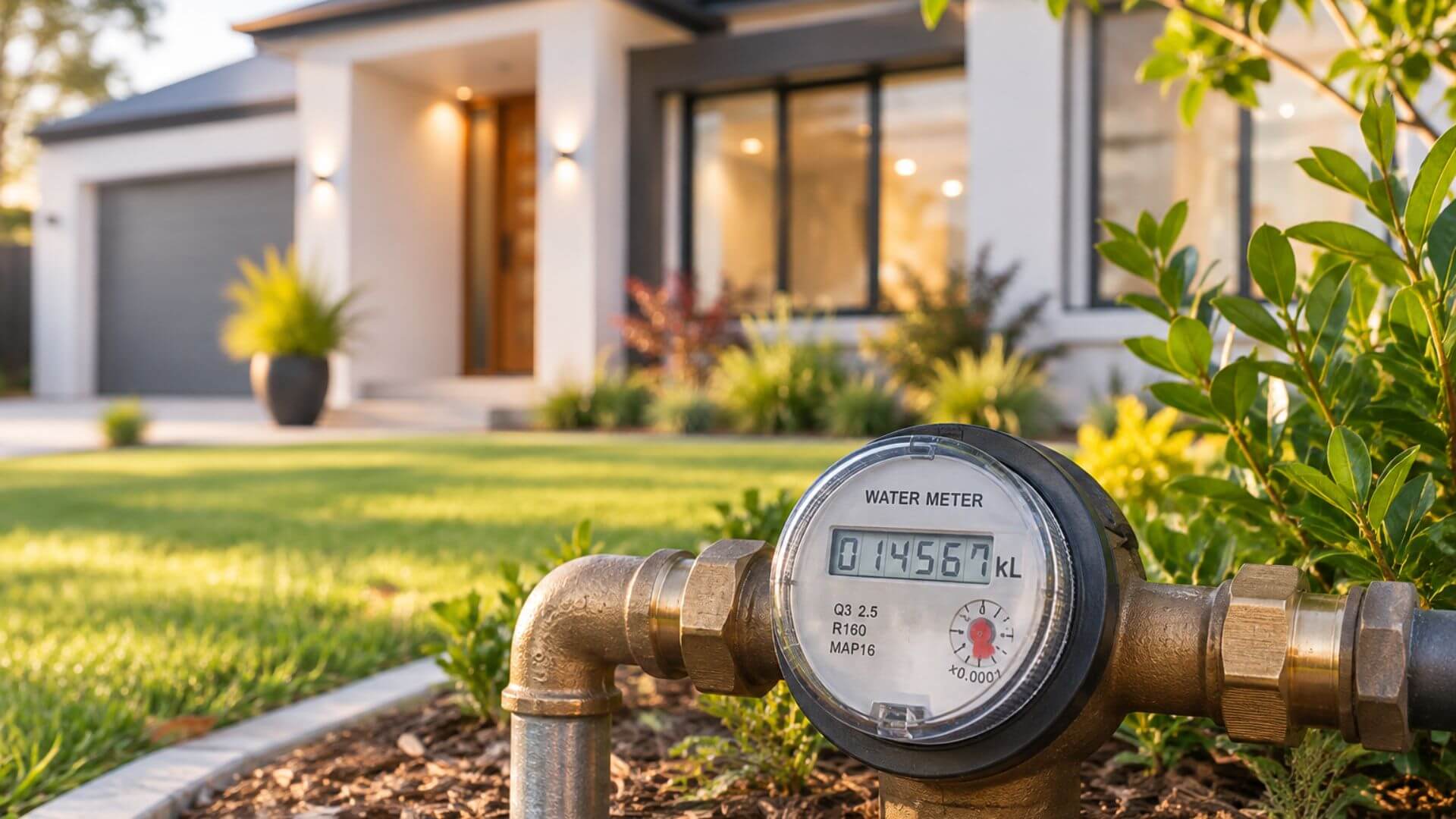
A water meter provides a record of consumption.
One kilolitre equals 1,000 litres of water. SA Water meters display the information needed to calculate usage between two readings.
For example, if the meter reads:
125 kL at the beginning of the tenancy
and:
145 kL at the end of the relevant period
the difference is 20 kL of water usage.
The applicable water usage rates can then be used to calculate the relevant charge.
Accurate entry and exit readings are particularly useful when a tenancy begins or ends between SA Water’s scheduled meter readings.
What happens if the water meter is shared?
Some properties, particularly units or grouped dwellings, may share a single water meter.
In this situation, the individual consumption for each home cannot simply be determined from its own meter.
Where more than one property is connected to the same meter, the tenancy agreement must include a term explaining how the water usage charges will be divided.
South Australian Government guidance notes that calculating a percentage based on the number of properties and tenants is one possible approach.
Tenants should check their tenancy agreement so they understand how their share is being calculated.
What must landlords provide when charging a tenant?
If eligible water charges are passed on to a tenant, the tenant needs to be able to see where those charges came from.
A copy of the supplier’s invoice detailing the relevant charges must be provided.
There is also an important timeframe.
If the landlord or agent does not provide the tenant with a copy of the invoice for charges incurred by the tenant within 30 days of the invoice being issued, the tenant is not required to pay those charges.
For landlords and property managers, timely water billing is therefore more than good administration.
What if the water bill seems unusually high?
An unexpectedly large water bill shouldn’t automatically be assumed to be normal household usage.
Leaks and plumbing faults can significantly increase water consumption.
Tenants should report leaking taps, running toilets and other plumbing problems to their landlord or property manager as soon as they notice them.
Under South Australian tenancy laws, the landlord is responsible for excessive water usage charges caused by a fault in water infrastructure, equipment, appliances, fittings or fixtures at or connected to the property, provided the tenant has notified the landlord of a known fault as soon as practicable.
This does not apply where the fault was caused by the tenant.
Reporting problems quickly can help protect the property, reduce unnecessary water waste and establish what caused an unusual increase in consumption.
What if SA Water couldn’t read the meter?
Sometimes SA Water cannot safely access a property’s water meter.
When this happens, the bill may be based on an estimated reading using previous consumption at the property or average usage for similar homes.
An actual meter reading can then be provided to SA Water if required.
If a water bill looks unexpectedly high or unusual, checking whether the reading was actual or estimated can be a useful place to start.
What should landlords and tenants remember about water charges?
The simplest way to avoid confusion is for everyone to understand the arrangements from the beginning of the tenancy.
For landlords, that means making sure the tenancy agreement clearly explains applicable water charges, maintaining accurate records and providing invoices within the required timeframe.
For tenants, it means understanding what the tenancy agreement says, checking the information supplied with a water charge and reporting leaks or plumbing faults promptly.
For both parties, accurate water meter readings at the beginning and end of a tenancy can make calculating usage much clearer.
Understanding water charges doesn’t need to be complicated. Clear agreements, accurate records and good communication can prevent many of the problems that arise around water billing.
If your property is managed by AMKAR Real Estate and you have questions about a water charge or how your property’s water usage has been calculated, contact our property management team for assistance.
Disclaimer: This article provides general information only and does not constitute legal advice. Water charging arrangements can vary depending on the property and tenancy agreement. Landlords and tenants should refer to their tenancy agreement and current South Australian Government guidance or seek appropriate professional advice where required.